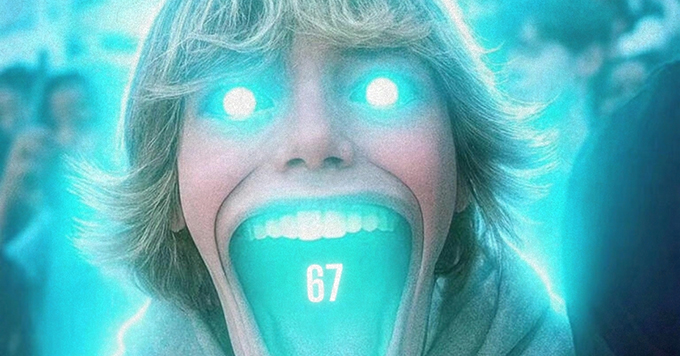
In 2024, “ brainrot ” was chosen as the Oxford Dictionary’s word of the year. The term highlights the mental deterioration caused by excessive consumption of trivial and low-quality digital content.
This year, 2025 , three prestigious linguistic authorities—Dictionary.com , the Cambridge Dictionary , and the Oxford English Dictionary —suggest a shift to a more active and complex phase. Digital “slang” points to tactics of emotional manipulation (“ rage bait ”), illusions of intimacy (“ parasocial ”), and absurd codes of belonging (“6-7”) as a snapshot of contemporary culture.
6-7: The Code of the Absurd
Dictionary.com selected “ 6-7 ” (or simply “67”) as its word of the year. This term only seems to make sense to Generation Alpha (born between 2010 and 2024). Its origin traces back to the song “ Doot Doot (6 7) ” by rapper Skrilla , and it has become popular through viral memes on TikTok and YouTube, becoming the perfect example of the breakneck speed of digital slang .
What stands out about “6-7” is not its definition, but the lack thereof. Often accompanied by a hand gesture, it means “more or less,” “maybe this or that,” although sometimes it means absolutely nothing.
There is no consensus among Generation Alpha regarding its exact meaning. It is even used as a tool to mock or annoy adults or teachers.
Dictionary.com describes it as an example of ” brainrot slang ,” that is, intentionally absurd and nonsensical terms designed to be endlessly remixed, as was the case with ” Italian brainrots .”
Its use is a sign of tribal identity, a digital “shibboleth”—a linguistic feature that indicates or reveals a person’s social or regional origin—generated by the user community. This demonstrates that online culture values connection and performance over traditional semantic meaning.
Parasocial: artificial intimacy
While “6-7” speaks of generational differences, the Cambridge Dictionary’s word of the year, “ parasocial ”, points to a desperate search for recognition.
The term was coined in 1956 to explain the fictitious intimacy that audiences formed with media figures. In 2025, it takes on a new dimension in the wake of social media and artificial intelligence.
The concept defines a one-sided relationship between an anonymous person and a celebrity or influencer who is unaware of the former’s affection (a fan). This year, the term expanded due to phenomena such as the relationship between Taylor Swift and Travis Kelce , but also because of the increasing human connection with artificial intelligence .
In today’s digital ecosystem, users are developing emotional relationships with chatbots and virtual companions . Digital interactions with AI and algorithms are reshaping human loneliness. It’s a way of filling the social void with simulations that, although one-sided, generate genuine feelings of loyalty and affection.
Rage bait : the monetization of anger
Finally, the Oxford Dictionary has chosen ” rage bait ” as its word of the year. This concept highlights a fundamental shift in how attention is captured online. Rage bait is the evolution of clickbait and refers to content deliberately designed to provoke outrage, offense, or anger, with the sole aim of increasing engagement.
The rise of the term demonstrates that the algorithms of social networks and digital platforms have learned a dangerous lesson: anger spreads faster and generates more engagement than joy or neutrality. Thus, rage bait turns negative emotions into advertising revenue for others.
Oxford notes that the use of this term has tripled in the last year. Its impact relates to how the algorithm manipulates users into participating in polarizing debates . The consequences are mentally exhausted citizens and a deterioration of institutions and the democratic model.
Adaptation to a hostile environment
Analyzing “6-7,” “parasocial,” and “ rage bait ” together reveals a picture of how the digital sphere influences society. These words are not mere linguistic curiosities, but rather evidence of behavioral adaptation to a hostile environment shaped by technology.
The lack of values, coupled with information overload and manipulation, leads younger users to respond with “6-7” almost irrationally. This defense mechanism uses absurdity and nonsense (characteristics of brain rot ) to create community without the need for substantial content. It’s a playful response to information overload, a way to build community without making a big deal out of anything concrete.
Furthermore, the resurgence of “parasocial” behavior demonstrates that digital hyperconnectivity has not resolved basic loneliness. It has simply redirected it toward entities that reciprocate affection in a substitute way. Technology allows us to simulate companionship, altering our ability to distinguish between real and transactional relationships.
Finally, the dominance of rage bait confirms society’s vulnerability to algorithms that exploit our most basic instincts and behaviors of defense and aggression. If brain rot is the fatigue of passive scrolling , rage bait is the fatigue of actively manipulating our emotions.
The words of 2025 suggest that digital culture is an active agent of social psychology. Oscillating between untranslatable absurdity, false intimacy, and manufactured anger, 2025 screams that emotions are being hacked, reprogrammed, packaged, and sold. Is language changing to give words to this new reality we are experiencing?
Author Bios: Pavel Sidorenko Bautista is Full Professor at the Faculty of Education and Humanities at UNIR – International University of La Rioja, José María Herranz de la Casa is Professor of Journalism at the University of Castilla-La Mancha and María Abellán Hernández is Professor of Communication at the University of Murcia
